
What is Search Engine Marketing in 2026
If you’ve ever poured money into Google Ads and watched it disappear without a single lead to show for it, you already know that most advice on search engine marketing barely scratches the surface. The popular guides will tell you to “pick the right keywords” and “write compelling ad copy.” Sure — but that’s like being handed a scalpel and told to “do surgery.”
This article goes deeper. We’ve analysed what the top-ranking search engine marketing articles are missing, and what we found is pretty telling: nobody’s talking about the mechanics that actually determine whether you win or lose. No AI disruption discussion. No budget reality checks. No match type breakdowns. No explanation of why a competitor with half your budget keeps outranking you.
5 Best SEO (Search Engine Optimisation)Tips for Beginners in 2026.
Does Search Engine Marketing Still Work in the Age of AI Search?
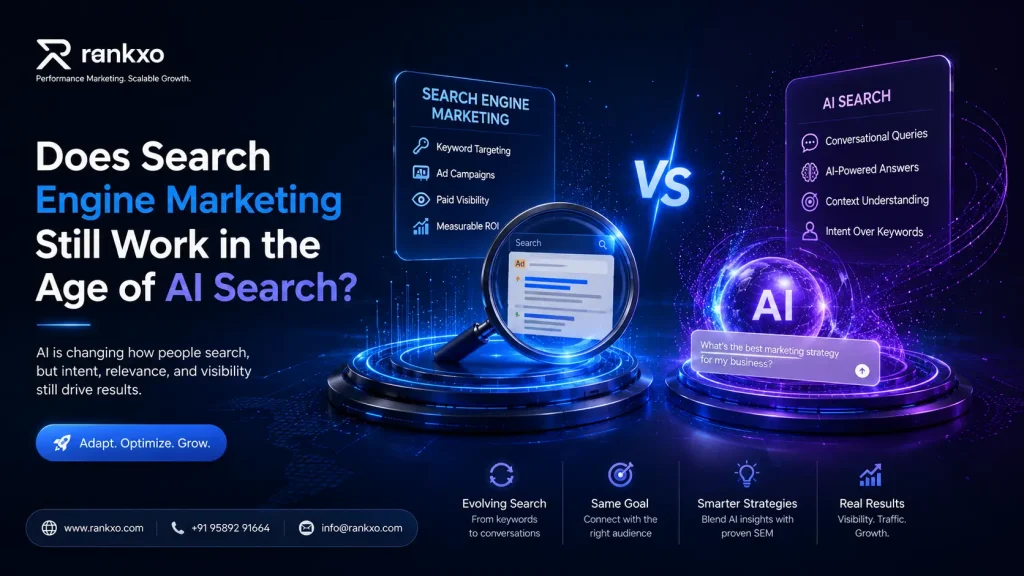
Let’s address the elephant in the room first — because if you’re spending money on paid search advertising in 2026, you’ve probably asked yourself this.
Google’s AI Overviews, Perplexity, and ChatGPT Search are genuinely changing how people interact with search results. Click-through rates on organic results have dropped in categories like health, finance, and general information queries. It’s real, and it’s ongoing.
But here’s what the data actually shows: the queries most affected by AI answers are informational — “what is,” “how does,” “explain to me.” These are not the queries that search engine marketing campaigns run on.
Paid search advertising targets transactional and commercial intent. Someone typing “emergency plumber near me” or “buy ergonomic office chair under ₹15,000” is not looking for an AI overview. They’re ready to act. Your ads still appear above everything else — including the AI box — for these kinds of searches.
The honest answer: search engine marketing still works, possibly better than ever for high-intent queries, because AI is hoovering up the informational traffic that was never converting well anyway. What changes is that you need to be smarter about where you direct your spending. More on that shortly.
How AI Overviews Are Changing Where Your Ads Actually Show Up
Google has confirmed that ads continue to show in standard placements even when AI Overviews are triggered. However, there’s a subtlety worth understanding: as AI satisfies more top-of-funnel curiosity, the searchers who do click on ads are likely to be further down the buying journey. That’s actually good news for conversion rates — your clicks become more qualified.
The implication for your PPC campaigns: stop bidding on educational keywords and double down on commercial ones. Keywords like “best,” “near me,” “buy,” “hire,” “quote,” “price,” and “review” indicate someone past the research stage. Prioritise those, and you’ll stay insulated from most AI disruption.
What Google’s AI Mode Means for Your PPC Budget Right Now
Google’s AI Mode (currently rolling out in the US) is a separate search experience where AI handles multi-step reasoning queries. At the time of writing, standard text ads still appear in AI Mode results, but the landscape is actively shifting.
The practical takeaway: keep a close eye on your impression share and CTR month-over-month. If you see impressions holding but CTR dropping on specific keywords, that’s AI eating your real estate. Adjust bids and creative accordingly. This isn’t a reason to abandon SEM — it’s a reason to be more precise with it.
How Much Should You Actually Spend on Search Engine Marketing? (A Realistic Breakdown)
Most beginner guides skip this entirely, which is maddening — because the budget question is the first thing every business owner actually asks.
Here’s the honest version:
The minimum viable search engine marketing budget depends on your industry’s cost per click (CPC). If you’re in a low-competition category — say, speciality pet supplies or handmade home décor — you might get meaningful data with ₹15,000–₹25,000 per month. If you’re in legal services, insurance, or finance, a single click can cost ₹800–₹10,000. At that rate, a ₹25,000 budget gives you almost nothing to work with.
A rough rule: you want at least 100 clicks per month on your target keywords to gather statistically useful data. Multiply your average CPC by 100 — that’s your floor.
For most small businesses entering SEM for the first time, a realistic starting budget falls between ₹30,000 and ₹75,000 per month. That’s enough to test a handful of ad groups, learn what converts, and make informed decisions.
When Search Engine Marketing Is a Waste of Money — and What to Do Instead
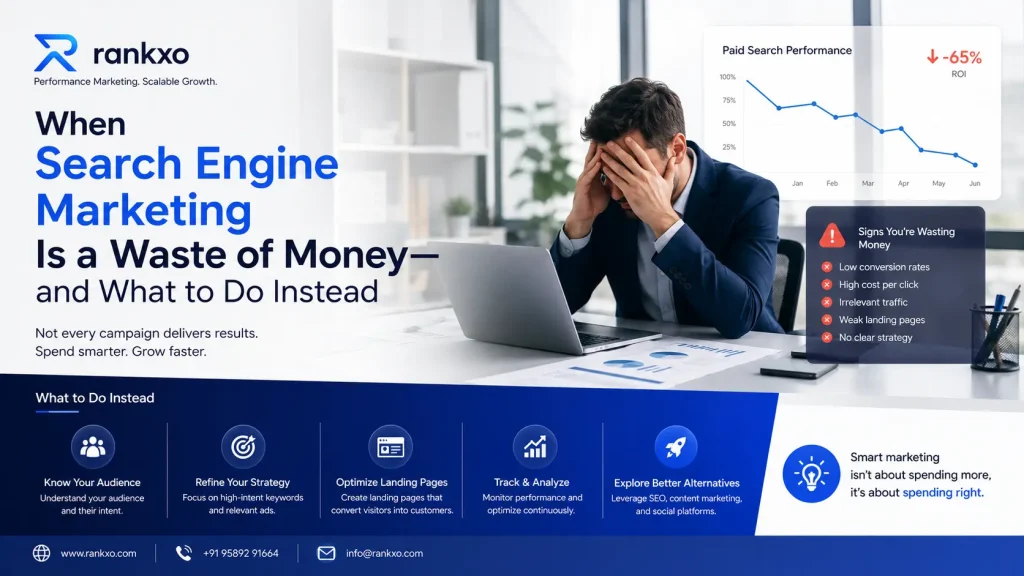
Search engine marketing is not always the right move. Here’s when it probably isn’t:
Your average order value is too low. If you’re selling a ₹299 product and your CPC is ₹120, you need an extraordinary conversion rate to make it work. The math often doesn’t.
You don’t have a clear landing page. Sending paid traffic to your homepage is one of the most common and expensive mistakes in search engine marketing. If your page isn’t designed to convert — with a specific headline, a clear CTA, and a fast load time — you’re paying for traffic that bounces.
You’re trying to build long-term brand authority. SEO, content marketing, and PR build compounding value over time. Search engine marketing traffic stops the moment you stop paying. If brand equity is the goal, SEM alone isn’t the strategy.
In these cases, use that budget for SEO content or a conversion rate optimisation audit first. Come back to SEM when you have pages that can actually close the deal.
How to Stretch a Small Search Engine Marketing Budget Without Getting Burned
If you are going ahead with a limited budget, here’s how to protect it:
Start with exact- and phrase-match keywords only. (More on this below.) Broad match will eat your budget on irrelevant searches before you’ve learned anything.
Cap your daily spend aggressively. Set daily budgets 20–30% lower than you’re comfortable with for the first 30 days. You can always raise them — you can’t get refunds.
Run ads during your highest-converting hours only. Most businesses see conversion spikes in specific windows. Use ad scheduling to focus your spend there.
Exclude mobile placements initially. Mobile traffic often has lower conversion rates, especially for B2B and high-consideration purchases. Test the desktop first.
Importance Of Digital Marketing and Time Management
Keyword Match Types Explained: The Setting That Quietly Drains Your Budget
Here’s the thing almost nobody explains properly: choosing a keyword isn’t just about the word itself. It’s about the match type you assign to it — and that single decision can be the difference between a profitable campaign and burning through your budget in three days.
There are three main match types in Google Ads:
Broad Match shows your ad for any search that Google thinks is related to your keyword, however loosely. Type “running shoes” as a broad match keyword, and you might show up for “free workout videos” or “sports injury treatment.” It casts the widest net — and creates the most wasted spend.
Phrase Match shows your ad when the search contains your keyword phrase, in roughly that order, possibly with other words around it. “Running shoes for flat feet” would trigger an ad for the phrase match keyword “running shoes.” More controlled, but still wide enough to surface surprises.
Exact Match shows your ad only when the search very closely matches your keyword. It’s the most controlled option and typically the most efficient for tight budgets.
For most businesses starting in search engine marketing, the smartest approach is to launch with phrase and exact match keywords. Run for 30–45 days. Then pull your search terms report to see the actual queries triggering your ads — you’ll find hidden opportunities and, more importantly, terms you never want to show up for again.
Broad vs. Phrase vs. Exact Match: Which One Should You Actually Use?
The answer depends on your budget and your goals:
If you have a generous budget and want to discover new keyword opportunities, broad match (monitored closely) can surface terms you hadn’t considered. You need to pair it with aggressive negative keywords to keep it from spiralling.
If you have a moderate budget and want controlled reach, phrase match is your workhorse. It balances visibility with relevance.
If you have a tight budget and highly specific products or services, an exact match is your safest bet. You’ll get fewer impressions, but the ones you get will be far more relevant.
In practice, most well-managed campaigns use a blend of all three, with different bids assigned to each.
Negative Keywords: The Most Underused Tool in Search Engine Marketing
If match types are about controlling what triggers your ad, negative keywords are about what definitely doesn’t.
A negative keyword tells Google: “Never show my ad when this word or phrase appears in a search.”
If you run a premium branding agency, you don’t want your ad appearing for “free logo maker” or “cheap branding services.” Adding “free” and “cheap” as negative keywords prevents that wasted spend immediately.
Here’s a simple process: before launching any campaign, brainstorm 20–30 terms that might be adjacent to your keyword but represent entirely wrong intent. Add those as negatives from day one. Then review your search terms report weekly for the first month to catch anything you missed.
Agencies running mature search engine marketing accounts often have negative keyword lists of 500+ terms. It’s not unusual — it’s disciplined budget protection.
SEO Mistakes Small Businesses Make (And How to Avoid Them)
Quality Score: The Hidden Factor That Decides Your Ad Rank (Not Just Your Bid)
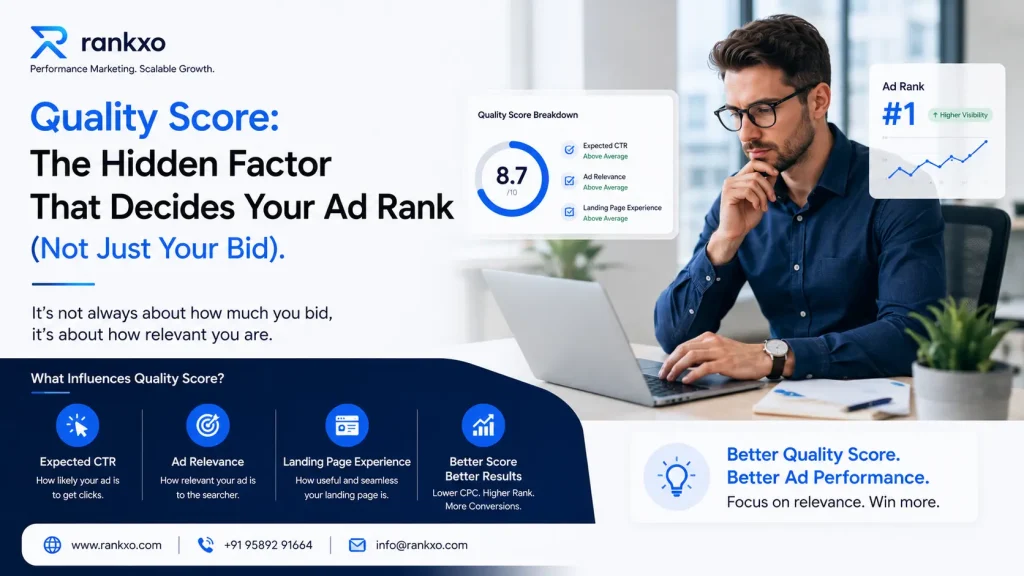
This is the one that trips up most first-time advertisers: you do not win ad placements simply by bidding the most. Google uses a metric called Quality Score — a 1–10 rating assigned to each keyword in your account — to determine your actual ad rank.
Ad Rank = Your Bid × Your Quality Score (simplified)
Quality Score is primarily determined by three things:
Expected click-through rate (CTR): Does Google predict that searchers will click your ad? If your ad copy is vague or mismatched, your expected CTR drops.
Ad relevance: How closely does your ad copy match the intent behind the keyword? Bidding on “accountant for small business” but running an ad that talks about enterprise tax software signals a mismatch.
Landing page experience: When someone clicks through, does your page deliver what the ad promised? Page speed, mobile-friendliness, and content relevance all factor in.
A high Quality Score means you pay less per click for the same (or better) position. An advertiser with a Quality Score of 8 can outrank a competitor with double the bid but a Quality Score of 4 — and pay less for the privilege.
How to Improve Quality Score and Pay Less Per Click
The levers you have:
Tighten the keyword–ad–landing page alignment. Your ad headline should echo the keyword. Your landing page headline should echo the ad. It should feel like a seamless journey, not a series of disconnected jumps.
Create tightly themed ad groups. Don’t cram 50 keywords into one ad group. Group 3–7 tightly related keywords together so you can write ad copy that genuinely speaks to each group.
Improve your landing page speed. Google measures load time as part of the landing page experience. Use Google PageSpeed Insights — anything below 80 on mobile is hurting you.
Test multiple ad variations. More ad copy tests = better CTR data = improved expected CTR score over time.
Why a Smaller Advertiser Can Outrank You Even With a Lower Budget
It’s one of the counterintuitive truths of search engine marketing: a lean, well-optimised account from a small business can consistently outperform a large brand running sloppy campaigns.
If your competitor has a Quality Score of 9 and you have a 4, they’re paying roughly half what you pay per click — and ranking above you. That’s not a budget problem. That’s an account quality problem.
The fix isn’t spending more. It’s spending better: tighter ad groups, more relevant copy, faster landing pages, and obsessive attention to what your search terms report is telling you.
Search Engine Marketing Strategy Isn’t One-Size-Fits-All: A Guide by Business Type
Every search engine marketing guide you’ve ever read treats “a business” as a monolithic entity. But an e-commerce store, a local plumber, and a SaaS company have fundamentally different goals, sales cycles, and conversion metrics. Here’s how the strategy shifts.
Search Engine Marketing for E-commerce: When ROAS Is Everything
For e-commerce, the north star metric is Return on Ad Spend (ROAS) — how much revenue you generate for every rupee spent on ads.
A target ROAS of 4x (₹4 in revenue for every ₹1 spent) is a common starting benchmark, though this varies wildly by margin. If you’re running on 20% margins, 4x ROAS barely covers your costs. Know your margin before setting your ROAS targets.
For e-commerce specifically:
- Use Shopping campaigns alongside search text ads — they typically drive stronger purchase intent.
- Set up dynamic remarketing to bring back cart abandoners.
- Organise campaigns by product category and bid higher on best-sellers.
- Implement conversion tracking at the transaction level, not just “add to cart.”
The ad auction for e-commerce keywords is particularly competitive. Make your product titles, descriptions, and prices competitive before sinking budget into ads — the traffic is only as valuable as the store it lands on.
Search Engine Marketing for Local Services: The Call Extension Playbook
If you’re a plumber, dentist, electrician, lawyer, or any service business where the conversion is a phone call or booked appointment, local search engine marketing has a distinct playbook.
Enable call extensions on every campaign — these display your phone number directly in the ad and let mobile users call with one tap. Call-only ads (where clicking the ad calls you directly rather than visiting a website) often outperform standard text ads for local service searches.
Use location targeting aggressively. If you serve a 15km radius, don’t let your ads show to the entire city. Tighter geo-targeting means more relevant clicks and less wasted spend.
Use bid adjustments to increase bids during your business hours. A 24-hour plumbing service is an exception — but most local services convert dramatically better when they can actually answer the phone.
Search Engine Marketing for B2B: Running Ads When the Sales Cycle Is 6 Months Long
B2B search engine marketing operates differently because almost nobody converts on the first click. The sales cycle is long. Decision-making involves multiple stakeholders. And the lifetime value per customer is high.
This changes everything about how you measure search engine marketing success.
Stop optimising purely for leads. A “lead” in B2B could be someone who downloaded a whitepaper and will never buy. Instead, track qualified leads — those who book a demo, request a quote, or reach a minimum qualifying threshold.
Use remarketing lists aggressively. Most B2B buyers research for weeks before contacting a vendor. Staying in front of them through display remarketing during that window keeps your brand top of mind.
Consider longer conversion windows in your attribution. A B2B customer who first clicked your ad in January might not convert until April. Standard 30-day attribution windows miss this entirely — use 90-day or full data-driven attribution instead.
Importance of Digital Marketing in 2026
10 Frequently Asked Questions About Search Engine Marketing
1. What is the difference between SEM and SEO? SEO (search engine optimisation) earns organic rankings through content, backlinks, and technical website health — it’s unpaid and builds over time. Search engine marketing refers to paid ads that appear in search results immediately. Both are valuable; most businesses benefit from using them together.
2. How long does it take to see results from search engine marketing? Ads can go live within hours of setting up a campaign. However, meaningful data — enough to make optimisation decisions — typically takes 2–4 weeks, and a truly optimised, profitable search engine marketing campaign usually takes 2–3 months to develop.
3. Is Google Ads the only option for search engine marketing? No. Microsoft Advertising (formerly Bing Ads) runs ads on Bing, Yahoo, and DuckDuckGo. It’s significantly cheaper per click and reaches an audience that skews slightly older and more affluent. For many businesses, running both platforms outperforms Google Ads alone.
4. What is a good Quality Score in Google Ads? A Quality Score of 7–10 is considered strong. Scores of 4 or below indicate something is misaligned — usually between ad copy, keyword intent, or landing page content. Improving from a 4 to a 7 can reduce your cost per click by 30–50%.
5. How do I know if my search engine marketing campaign is working? The key metrics to track: conversion rate, cost per conversion, ROAS (for e-commerce), and return on investment. Clicks and impressions alone tell you nothing about profitability. Make sure conversion tracking is set up before launching.
6. Can I run SEM on a budget of ₹10,000 per month? It depends entirely on your industry’s cost per click. In low-competition niches, ₹10,000 can generate useful data. In competitive categories, you may get 10–20 clicks and learn almost nothing. Do your keyword CPC research first and be honest about whether the budget is viable.
7. What are negative keywords, and why do they matter? Negative keywords prevent your ads from showing for irrelevant searches. They protect your budget from being spent on traffic that will never convert. Building a robust negative keyword list is one of the highest-ROI activities in SEM account management.
8. How does the Google Ads auction work? Every time a user searches, Google runs an auction in milliseconds. Your Ad Rank is calculated from your bid multiplied by your Quality Score (plus other factors like ad extensions). The highest Ad Rank wins the top position — not necessarily the highest bid.
9. Should I manage search engine marketing (SEM) myself or hire an agency? Small budgets (under ₹50,000/month) are often better managed in-house with the right learning investment, since agency fees can eat a significant percentage of a small budget. Larger budgets, or campaigns across multiple platforms and product categories, typically benefit from specialist management.
10. How does remarketing fit into SEM? Remarketing lets you show ads specifically to people who’ve already visited your website. In the context of SEM, you can adjust bids upward for these users (since they’re warmer prospects) or run dedicated campaigns to bring them back. It’s one of the most cost-efficient layers you can add to any search engine marketing strategy.
The Bottom Line
Most search engine marketing content will walk you through the basics and leave you at the door. This article went further — because the basics alone aren’t what’s costing advertisers money in 2026.
What actually costs you money: bidding on the wrong match types, ignoring Quality Score, running ads to poorly built landing pages, and using a one-size-fits-all strategy regardless of whether you’re running a local bakery or a SaaS platform.
What actually makes you money: understanding the mechanics of the ad auction, building tight campaigns with deep negative keyword lists, obsessing over landing page relevance, and knowing which business-type playbook applies to your situation.
The businesses winning at search engine marketing right now aren’t the ones with the biggest budgets. They’re the ones who treat it like a system to be understood — not a tap to be turned on and hoped for the best.
Start with one well-structured campaign. Learn what the data tells you. Then scale what works.
Written with real-world SEM data and practitioner experience. All budget figures are illustrative and should be validated against your specific market and keyword costs before committing to spend.