
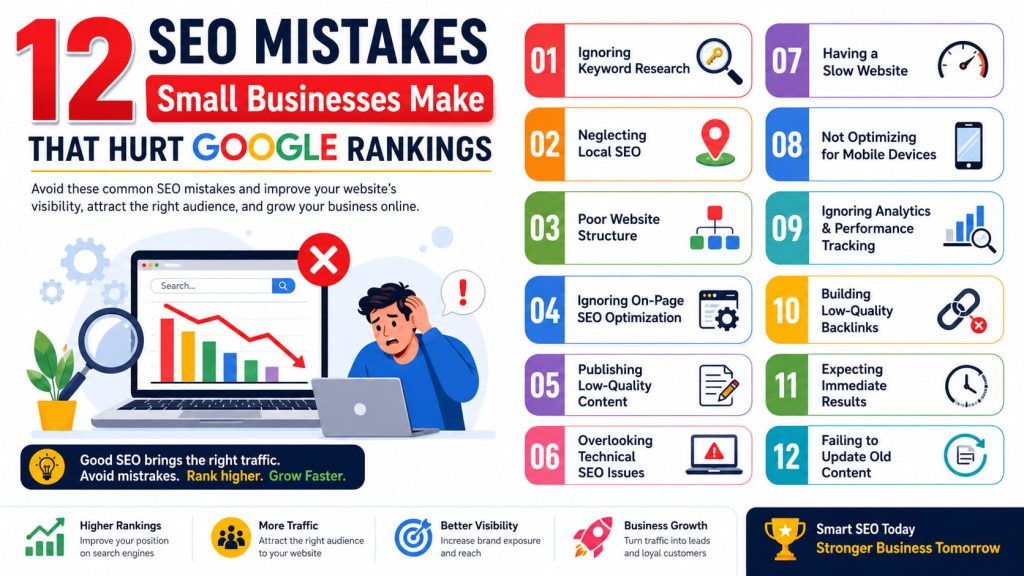
In today’s digital world, having a website is no longer enough. Your potential customers are searching online for products and services every day, and if your business doesn’t appear in search results, you’re likely losing valuable opportunities. Unfortunately, many businesses unknowingly make SEO mistakes that prevent them from achieving higher visibility and attracting qualified leads.
Search Engine Optimisation (SEO) is one of the most cost-effective ways to grow your business online. However, many small business owners either overlook SEO entirely or implement outdated practices that do more harm than good. Understanding the most common SEO mistakes small businesses make can help you build a stronger online presence and improve your search engine performance.
In this guide, we’ll explore the biggest SEO errors and show you how to fix them.
1. Ignoring Keyword Research
One of the most common SEO mistakes small businesses make is creating content without proper keyword research.
Many business owners assume they know what their customers are searching for. However, customer search behaviour often differs from business terminology. If you’re targeting the wrong keywords, your content may never reach the right audience.
Effective keyword research helps you identify terms that potential customers are actively searching for. Instead of targeting highly competitive keywords, focus on long-tail keywords that match user intent and have realistic ranking opportunities.
A solid small business SEO strategy always begins with understanding what your audience is searching for.
2. Neglecting Local SEO
For businesses serving a specific geographic area, ignoring local SEO can significantly limit growth.
Imagine running a plumbing service in Delhi or a digital marketing agency in Greater Noida. If your website isn’t optimised for local searches, you’re missing potential customers who are actively looking for your services nearby.
Some essential local SEO tips include:
- Optimising your Google Business Profile
- Using location-based keywords
- Creating location-specific landing pages
- Encouraging customer reviews
- Maintaining consistent business information across directories
Local SEO helps businesses appear in map results and local search listings, increasing visibility among nearby customers. The above pointers can prevent a business owner from making the SEO mistakes that small businesses make
Also Read:- 5 Best SEO (Search Engine Optimisation)Tips for Beginners in 2026.
3. Poor Website Structure
A confusing website structure creates a poor experience for both users and search engines.
When visitors cannot easily find information, they leave quickly. Search engines also struggle to understand and index your content effectively.
Your website should have:
- Clear navigation menus
- Organized categories
- Internal linking between related pages
- Easy access to important information
- Mobile-friendly design
Website structure is one of the critical website ranking factors that influence user experience and search visibility. By making website mobile friendly a business owner can prevent himself for making SEO mistakes that small businesses make.
4. Ignoring On-Page SEO Optimisation
Many small businesses publish content without optimising it properly.
Creating quality content is important, but search engines also need signals to understand what your page is about. This is where on-page SEO optimisation plays a vital role.
Important on-page elements include:
- Title tags
- Meta descriptions
- Header tags (H1, H2, H3)
- Image alt text
- Internal links
- Keyword placement
Avoid keyword stuffing and focus on naturally integrating keywords into your content. Search engines are becoming increasingly sophisticated and prioritise relevance and user value over excessive keyword usage.
Also Read: 5 Best SEO (Search Engine Optimisation)Tips for Beginners in 2026.
Also Read: Importance Of Digital Marketing and Time Management
5. Publishing Low-Quality Content
Content remains one of the strongest ranking factors in SEO.
Unfortunately, many small businesses publish short, generic, or poorly written content that offers little value to readers. Search engines prioritise content that answers user questions and provides useful information.
To improve content quality:
- Solve real customer problems
- Answer frequently asked questions
- Include practical examples
- Update content regularly
- Write in a clear and conversational tone
Quality content not only improves rankings but also helps establish trust and authority within your industry.
6. Overlooking Technical SEO Issues
Even the best content can struggle to rank if your website suffers from technical SEO issues. Technical SEO focuses on how well search engines can crawl, understand, and index your website.
Common technical problems include:
- Broken links
- Slow page speed
- Duplicate content
- Missing XML sitemap
- Crawl errors
- Poor mobile usability
Regular website audits can help identify and resolve technical issues before they negatively impact your search performance. Investing in technical SEO ensures that your website provides a smooth experience for both users and search engines.
7. Having a Slow Website
Website speed has become increasingly important for SEO and user experience.
Today’s internet users expect pages to load almost instantly. If your website takes too long to load, visitors are likely to leave before viewing your content.
A slow website can result in:
- Higher bounce rates
- Lower conversions
- Reduced engagement
- Poor search rankings
To improve speed:
- Compress images
- Use quality web hosting
- Enable caching
- Minimize unnecessary scripts
- Optimize code
Fast-loading websites generally perform better in Google search rankings and provide a superior user experience.
8. Not Optimising for Mobile Devices
Mobile traffic now accounts for a significant portion of online searches. If your website isn’t mobile-friendly, users may struggle to navigate, read content, or complete actions such as filling out forms.
Google uses mobile-first indexing, meaning it primarily evaluates the mobile version of your website when determining rankings.
Ensure your website:
- Adapts to all screen sizes
- Loads quickly on mobile devices
- Has readable text
- Uses easy-to-click buttons
- Provides a seamless mobile experience
A responsive website is no longer optional; it’s essential.
9. Ignoring Analytics and Performance Tracking
Many small businesses implement SEO efforts without tracking results. Without analytics, it’s impossible to know what’s working and what needs improvement.
Important metrics to monitor include:
- Organic website traffic
- Bounce rate
- Keyword rankings
- Conversion rates
- User engagement
- Page performance
Tools like Google Analytics and Google Search Console provide valuable insights into website performance and user behaviour.
Regular analysis allows businesses to make informed decisions and continuously improve their SEO efforts.
Also Read: 5 Best tips to make a blog SEO friendly in 2026
Also Read: Affiliate Marketing Versus Drop Shipping
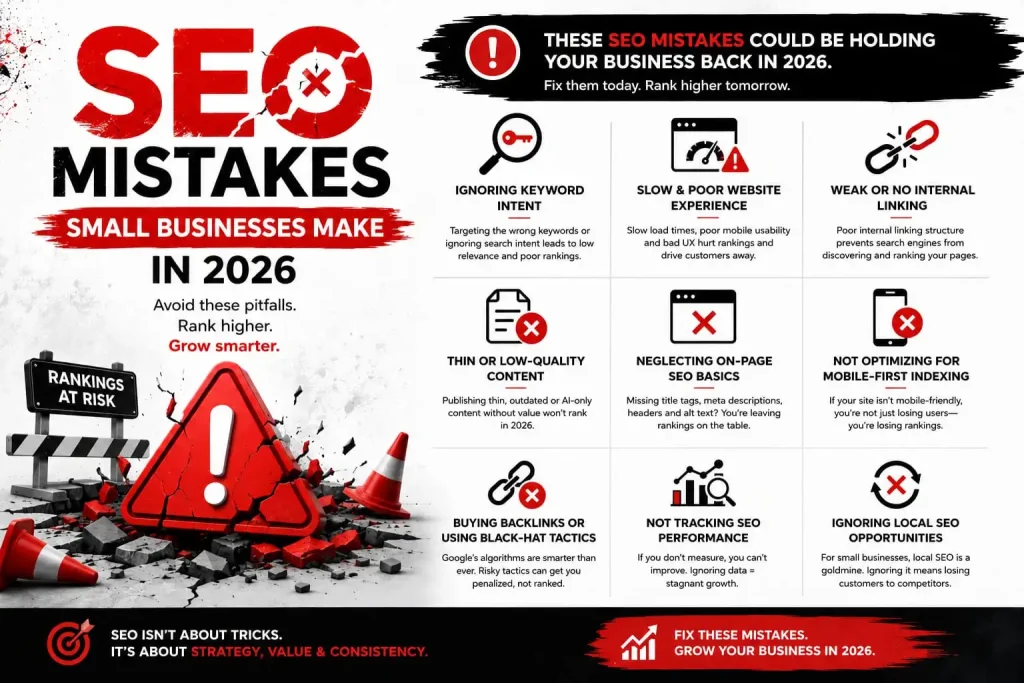
10. Building Low-Quality Backlinks
Backlinks remain an important ranking factor, but quality matters far more than quantity.
Some businesses purchase cheap backlinks or participate in link schemes, hoping for quick results. These tactics can lead to penalties and long-term ranking issues.
Instead, focus on earning quality backlinks through:
- Guest posting
- Creating valuable content
- Digital PR campaigns
- Industry partnerships
- Resource pages
A strong backlink profile helps improve authority and search visibility over time. These steps can help a business owner avoid SEO mistakes small businesses often make.
11. Expecting Immediate Results
SEO is a long-term investment, not a quick fix.
Many small business owners become discouraged when they don’t see immediate improvements and abandon their strategy prematurely.
SEO requires patience, consistency, and ongoing optimisation. Depending on the competition and industry, noticeable results can take several months.
Businesses that remain committed to their SEO efforts are often rewarded with sustainable growth and long-term visibility.
12. Failing to Update Old Content
SEO is not a one-time activity. Search trends, customer preferences, and algorithms constantly evolve. Content that performed well two years ago may now be outdated.
Regular content updates help:
- Maintain relevance
- Improve rankings
- Increase traffic
- Enhance user experience
- Demonstrate expertise
Review your content periodically and update statistics, examples, links, and information where necessary.
Also Read:- List of Top 10 Digital Marketing Institutes in Delhi NCR
Final Thoughts
Understanding the SEO mistakes small businesses make is the first step toward building a stronger online presence. From neglecting keyword research and local SEO to overlooking technical SEO issues and content quality, these common errors can prevent your website from reaching its full potential.
The good news is that most SEO mistakes are fixable. By focusing on on-page SEO optimisation, improving website performance, implementing local SEO tips, monitoring website ranking factors, and developing a sustainable small business SEO strategy, you can improve your Google search rankings and attract more organic website traffic.
SEO is a journey that requires consistency, patience, and continuous improvement. Businesses that invest in the right strategies today are far more likely to achieve lasting success tomorrow.
Also Read: Facebook ads v/s google ads, which one is better?